

Strong dissertation writing skills are not about using complex words or writing hundreds of pages in one go. They are about clarity, structure, research thinking, and the ability to communicate your ideas academically. Many students struggle not because they lack knowledge, but because they don’t know how to translate that knowledge into a well-structured dissertation.
If you want to improve your dissertation writing skills step by step, this guide will help you do exactly that.
Understand What Dissertation Writing Really Demands
It is not about filling pages; it is about presenting original ideas supported by strong academic evidence. It demands critical thinking, structured arguments, ethical research practices, and clear academic communication. Each chapter must serve a specific purpose, contribute to the research objective, and follow university guidelines. Understanding these expectations early helps students write with direction, confidence, and academic clarity. A dissertation is not an extended assignment. It requires:
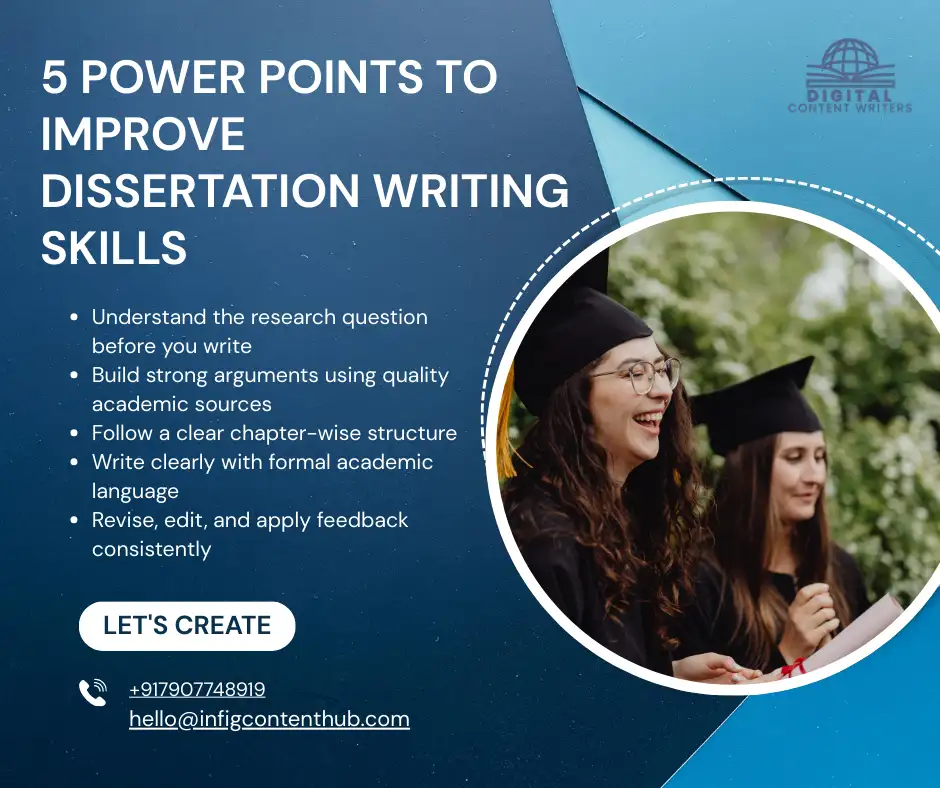
- Critical thinking, not just description
- Evidence-based arguments
- Logical chapter flow
- Academic tone and consistency
Strengthen Your Research Before You Write
Weak writing often comes from weak research. To improve dissertation writing skills:
- Read recent journal articles, not just textbooks
- Take structured notes instead of copying content
- Identify gaps, debates, and key theories in your field
Learn Chapter-Wise Writing Techniques
Mastering chapter-specific writing is a major step in improving dissertation writing skills. Each dissertation chapter requires a different writing approach:
- Introduction – sets context and direction
- Literature Review – evaluates, not summarizes
- Methodology – explains why methods were chosen
- Results & Discussion – interprets findings critically
Focus on Academic Clarity, Not Complexity
Strong dissertation writing skills are about clarity, not complication. Many students believe complex language equals good writing. In reality:
- Simple, precise sentences score better
- Clear arguments impress examiners
- Logical transitions improve readability
Improve Your Editing and Self-Review Process
Writing is only half the work. To refine dissertation writing skills:
- Edit in multiple rounds (structure → clarity → grammar)
- Read your work aloud to spot awkward phrasing
- Check if every paragraph supports your research aim
Use Feedback as a Skill-Building Tool
Responding effectively to feedback is one of the fastest ways to improve dissertation writing skills. Supervisor feedback is not criticism; it’s a roadmap.
Use comments to:
- Improve argument strength
- Fix structural weaknesses
- Refine academic tone
Practice Consistency in Referencing and Formatting
Attention to detail reflects advanced dissertation writing skills. Inconsistent citations and formatting weaken even strong content.
Develop skills in:
- APA, Harvard, or university-specific styles
- In-text citation accuracy
- Reference list consistency
Build Writing Discipline, Not Just Motivation
It improve with consistent practice, not last-minute pressure. Skill grows with routine. Set:
- Daily or weekly writing goals
- Fixed revision time
- Distraction-free writing blocks
Conclusion
Improving dissertation writing skills takes time, practice, and the right academic guidance. By strengthening your research approach, refining chapter-wise writing, and developing strong editing habits, you can significantly improve the quality of your dissertation and your overall academic confidence.
If you need structured academic support or expert guidance at any stage, explore DCWI to learn more about our academic services, or visit our Dissertation Writing Services page for professional help with research, writing, editing, and formatting. With the right support, writing a high-quality dissertation becomes a far more achievable goal.
Frequently Asked Questions
Dissertation writing skills include academic research, critical analysis, structured writing, proper referencing, and the ability to present original ideas clearly and logically.
You can improve dissertation writing skills by reading high-quality academic papers, practicing chapter-wise writing, revising regularly, and using supervisor feedback effectively.
Most students struggle due to weak research foundations, unclear structure, lack of academic writing practice, and poor time management rather than a lack of subject knowledge.
Research is crucial. Strong research improves argument clarity, critical thinking, and overall writing quality in a dissertation.
Yes. Using clear, formal, and precise academic language improves readability and demonstrates strong dissertation writing skills.
It varies, but consistent practice over weeks or months leads to noticeable improvement in structure, clarity, and confidence.
