

Table of Contents
The dissertation introduction is one of the most important chapters of your research. It sets the tone for your entire study and gives readers a clear understanding of what your research is about, why it matters, and how it will be conducted. A strong introduction not only captures attention but also convinces examiners that your research is valuable and well-planned.
Why is the Dissertation Introduction Important?
- Creates the first impression
- Explains the significance of the research
- Provides context
- Introduces research objectives
- Helps readers understand the study
Many students struggle with this section because it requires clarity, focus, and academic precision. This guide explains how to write an effective dissertation introduction step by step.
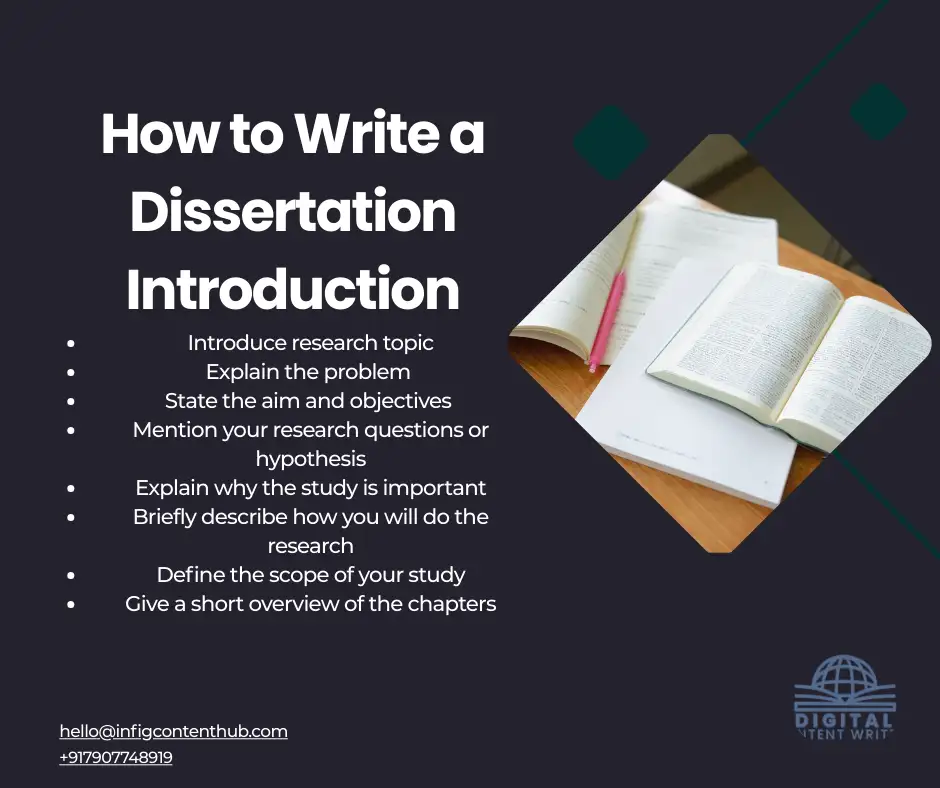
8 Steps to Write a Strong Dissertation Introduction
1. Start with a Clear Research Context
Begin your introduction by introducing the broader topic area of your research. Explain the background of the study and provide enough context for readers to understand the subject. This helps position your research within an existing academic or practical framework.
Tip: Move from a general discussion to a more specific focus related to your research topic.
2. Identify the Research Problem
Clearly state the problem or gap in existing research that your dissertation aims to address. This is one of the most critical elements of an effective introduction.
Ask yourself:
- What is missing in current research?
- What issue needs further investigation?
- Why is this problem important?
3. Explain the Purpose and Objectives of the Study
Outline the main aim of your dissertation and list the key research objectives. These objectives should be clear, concise, and aligned with your research problem.
Your objectives help readers understand what your dissertation intends to achieve and guide the structure of your research.
4. Present the Research Questions or Hypotheses
Depending on your research approach, include your research questions or hypotheses. These should directly relate to your objectives and clearly indicate the direction of your study.
- Qualitative research: Research questions
- Quantitative research: Hypotheses or testable statements
5. Highlight the Significance of the Study
Explain why your research is important. Discuss how your dissertation contributes to:
- Academic knowledge
- Practical applications
- Policy development or industry practices
6. Briefly Describe the Research Methodology
Provide a short overview of the research methodology you will use. Mention whether your study is qualitative, quantitative, or mixed-methods, along with key data collection techniques.
Keep this brief—detailed explanations belong in the methodology chapter.
7. Define the Scope and Limitations
Clarify the scope of your research, including boundaries such as time, location, sample size, or subject focus. You may also briefly mention limitations to manage reader expectations.
8. Outline the Structure of the Dissertation
Conclude your introduction by briefly explaining the structure of your dissertation. Summarize what each chapter covers so readers know what to expect.
Example:
Chapter One introduces the research background and objectives, Chapter Two reviews relevant literature, Chapter Three discusses the methodology, and so on.
Common Mistakes to Avoid
- Being too vague or overly detailed
- Introducing results in the introduction
- Poorly defined research problem
- Lack of clear objectives or research questions
- Weak connection between background and study focus
Academic Writing Style Tips
- Use formal language
- Avoid contractions
- Write objectively
- Use transitions
- Maintain consistency
Recommended Length of a Dissertation Introduction
| Dissertation Length | Suggested Introduction |
|---|---|
| 8,000 words | 800–1,000 words |
| 10,000 words | 1,000–1,200 words |
| 15,000 words | 1,200–1,800 words |
| 20,000 words | 1,500–2,000 words |
| 40,000+ words | 2,500–4,000 words |
Dissertation Introduction Checklist
- □ Background included
- □ Research problem explained
- □ Aim clearly stated
- □ Objectives listed
- □ Research questions included
- □ Significance discussed
- □ Scope defined
- □ Dissertation chapters introduced
- □ Grammar checked
- □ Referencing completed
Final Tips for Writing an Effective Dissertation Introduction
- Write the introduction after completing other chapters
- Keep your language formal and academic
- Ensure alignment between aims, objectives, and research questions
- Revise and refine for clarity and coherence
Conclusion
Writing a strong dissertation introduction can be challenging. At DCWI, we provide expert guidance to help students craft clear, compelling, and academically sound dissertation introductions. Our professional dissertation writing services support you at every stage—from topic selection to final submission. While your introduction sets the stage, your final chapter must mirror it perfectly. Read our complete guide on how to write a dissertation conclusion to tie your entire paper together.
Writing a dissertation requires strong research, structure, and critical thinking skills. If you want to enhance your approach, read our detailed guide on how to improve dissertation writing skills.
Frequently Asked Questions (FAQ)
It is usually 10–15% of the total dissertation word count, depending on university guidelines.
It should include the background, research problem, aims, objectives, research questions, methodology overview, and structure.
No. Results should be discussed only in the findings or results chapter.
Yes. The introduction gives detailed context, while the abstract is a short summary of the entire dissertation.
Yes. Professional dissertation writing services can help you write a clear, well-structured introduction that meets university standards.