
Table of Contents
Key Takeaways
- Orem’s Self-Care Deficit Theory states that nursing is needed when a person’s self-care demand is greater than their self-care ability.
- Dorothea Orem first published the theory in 1971.
- The theory has three parts: the theory of self-care, the theory of self-care deficit, and the theory of nursing systems.
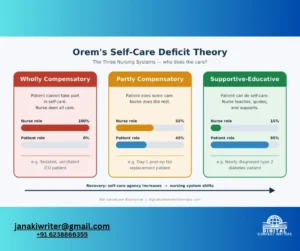
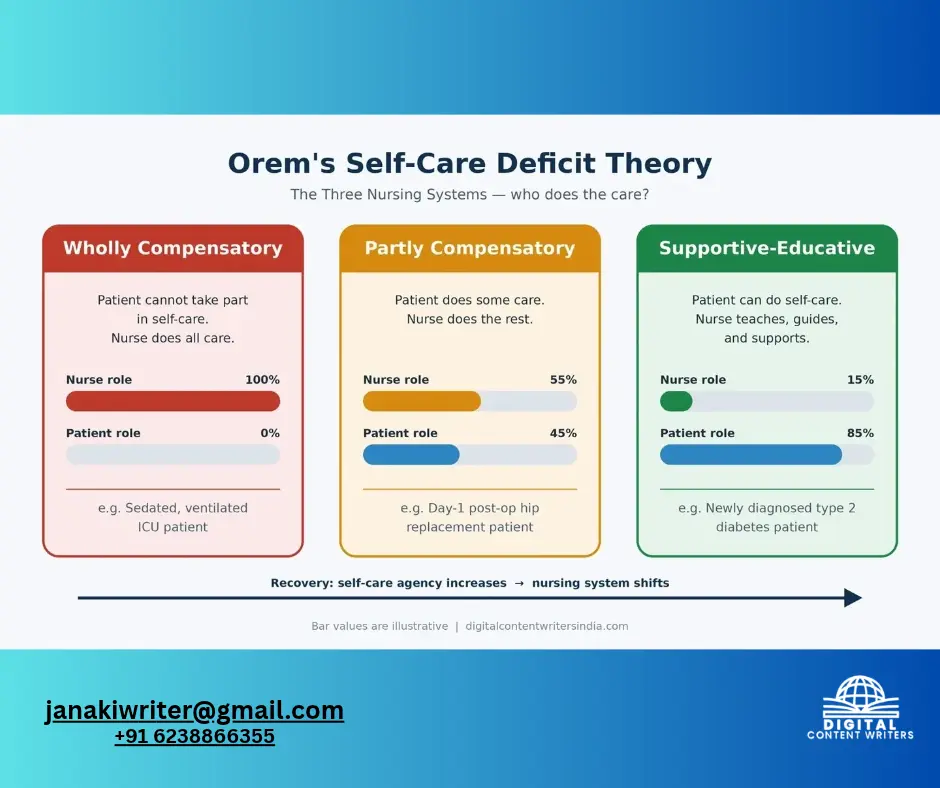
- Orem described three nursing systems: wholly compensatory, partly compensatory, and supportive-educative.
- Orem’s theory is widely used in care plans, chronic disease education, and nursing research.
What Is Orem’s Self-Care Deficit Theory?
Orem’s Self-Care Deficit Theory is a nursing theory that explains when and why a person needs nursing care. The theory states that adults can normally care for themselves. A self-care deficit occurs when health-related limits make a person’s care needs greater than their ability to meet them. Nursing care is needed to close that gap.
American nurse theorist Dorothea Elizabeth Orem (1914–2007) developed the theory. Orem first published it in Nursing: Concepts of Practice in 1971. Orem revised the book through six editions, the last in 2001. Nursing textbooks classify Orem’s theory as a grand nursing theory.
What Are the Three Parts of Orem’s Theory?
Orem’s Self-Care Deficit Theory has three connected parts: the theory of self-care, the theory of self-care deficit, and the theory of nursing systems. The theory of self-care describes what people need. The theory of self-care deficit explains when people need nursing. The theory of nursing systems explains how nurses should respond.
Part | Core Question | Key Concept |
Theory of Self-Care | What does a person need to stay healthy? | Self-care requisites |
Theory of Self-Care Deficit | When does a person need a nurse? | Demand vs. agency |
Theory of Nursing Systems | How much should the nurse do? | Three nursing systems |
What Is Self-Care in Orem’s Theory?
In Orem’s theory, self-care is the set of activities a person performs on their own behalf to maintain life, health and well-being. Self-care is learned behaviour. Self-care is deliberate and goal-directed. Culture, family and life stage shape how a person carries out self-care.
Universal Self-Care Requisites
Universal self-care requisites are needs shared by all humans. Orem listed eight universal requisites:
- Sufficient intake of air
- Sufficient intake of water
- Sufficient intake of food
- Care related to elimination
- Balance between activity and rest
- Balance between solitude and social interaction
- Prevention of hazards to life and well-being
- Promotion of normal human functioning (normalcy)
Developmental Self-Care Requisites
Developmental self-care requisites are needs linked to life stages and life events. Examples include pregnancy, infancy, adolescence, ageing and bereavement. A move into residential care is also a developmental event.
Health-Deviation Self-Care Requisites
Health-deviation self-care requisites are needs caused by illness, injury, diagnosis or medical treatment. Learning to use an inhaler is a health-deviation requisite. Caring for a stoma is a health-deviation requisite. Following a post-operative mobility plan is a health-deviation requisite.
What Is a Self-Care Deficit?
A self-care deficit is the gap between a person’s therapeutic self-care demand and their self-care agency. Therapeutic self-care demand is the total care a person needs at a given time. Self-care agency is the person’s actual ability to perform that care. A deficit exists when demand is greater than agency.
Self-care deficit = therapeutic self-care demand > self-care agency
What Are the Basic Conditioning Factors in Orem’s Theory?
Basic Conditioning Factor | Bedside Example |
Age | An 85-year-old patient recovering slowly |
Gender | Gender-specific health needs |
Developmental state | Adolescent patient with type 1 diabetes |
Health state | Patient with multiple chronic conditions |
Sociocultural orientation | Cultural food practices that affect diet plans |
Health care system factors | Access to follow-up clinics |
Family system factors | Availability of a family caregiver |
Patterns of living | Night-shift work that disrupts medication timing |
Environmental factors | Stairs at home after hip surgery |
Resource availability | Ability to afford medicines or equipment |
What Are the Three Nursing Systems in Orem’s Theory?
Nursing System | Patient Role | Nurse Role | Bedside Example |
Wholly compensatory | Cannot take part in self-care | Performs all self-care for the patient | Sedated, ventilated ICU patient |
Partly compensatory | Performs some self-care | Performs the rest of the care | Day-1 post-op hip replacement patient |
Supportive-educative | Can perform self-care with guidance | Teaches, guides and supports | Newly diagnosed type 2 diabetes patient |
What Are Orem’s Five Helping Methods?
Orem described five helping methods that nurses use to meet self-care deficits:
- Acting for or doing for another person
- Guiding and directing
- Providing physical or psychological support
- Providing an environment that promotes personal development
- Teaching
Wholly compensatory care relies mostly on acting for the patient. Supportive-educative care relies mostly on guiding, supporting and teaching.
How Does Orem’s Theory Apply to Post-Operative Patients?
Orem’s theory guides post-operative care by matching nursing help to the patient’s changing ability to self-care. Most post-operative patients start in a partly compensatory system. The nursing goal is to move them to a supportive-educative system before discharge.
Case example: Mr. R is 68 years old and one day post laparotomy. Mr. R has an IV line, a urinary catheter and wound pain. Mr. R is afraid to move.
- Universal requisites affected: activity and rest, elimination, nutrition, hazard prevention
- Health-deviation requisites: wound care, pain control, early mobilisation
- Nursing system: partly compensatory
- Nurse actions: help with hygiene, mobility and positioning
- Patient actions: deep-breathing exercises, PCA pump use
- Discharge goal: supportive-educative care, including teaching wound care and infection warning signs
How Does Orem’s Theory Apply in the ICU?
In the ICU, Orem’s theory starts with the wholly compensatory nursing system. A sedated, ventilated patient cannot perform self-care. The ICU nurse meets every universal self-care requisite for the patient.
Orem’s theory also guides ICU recovery. As sedation is weaned, the patient regains some self-care agency. The nurse then moves the patient toward partly compensatory care. Early mobility and daily sedation breaks fit Orem’s goal of restoring self-care agency.
How Does Orem’s Theory Apply to Elderly and Community Care?
In elderly and community care, Orem’s theory focuses on developmental requisites and environmental conditioning factors. Ageing is a developmental requisite. Living alone, home hazards and limited resources are conditioning factors. The nurse assesses the patient’s home life, not only the diagnosis.
Example: An older adult with mild cognitive decline may need a pill organiser, home safety changes and caregiver education. Each intervention targets a specific self-care deficit.
Is Orem’s Theory Still Relevant in Modern Nursing?
Yes. Orem’s Self-Care Deficit Theory remains relevant because modern healthcare emphasises patient self-management. Orem’s theory supports patient-centred care. Orem’s theory fits chronic disease management. Orem’s theory supports early discharge planning. Orem’s theory matches rehabilitation goals. Orem’s theory fits the nursing process.
How Do You Use Orem’s Theory in a Nursing Care Plan?
Step-by-step care plan framework:
- Assess the universal, developmental and health-deviation self-care requisites.
- Identify the basic conditioning factors that affect self-care agency.
- Compare therapeutic self-care demand with self-care agency.
- State the self-care deficit.
- Select the nursing system: wholly compensatory, partly compensatory, or supportive-educative.
- Plan interventions using Orem’s five helping methods.
- Evaluate whether self-care agency has improved.
- Adjust the nursing system as the patient’s ability changes.
How Do You Use Orem’s Theory in a Nursing Thesis or Dissertation?
Orem’s Self-Care Deficit Theory is one of the most widely used theoretical frameworks in nursing research. Researchers use Orem’s theory to study self-care behaviour, patient education, chronic illness and quality of life. To use Orem’s theory in a thesis, map each study variable to an Orem concept.
How Orem’s concepts map to research variables:
Research Element | Orem Concept |
Educational intervention | Supportive-educative nursing system |
Outcome: self-care ability | Self-care agency |
Participant characteristics | Basic conditioning factors |
Patient needs measured | Therapeutic self-care demand |
Validated measurement tool: The Exercise of Self-Care Agency (ESCA) scale measures self-care agency. Kearney and Fleischer developed the ESCA scale in 1979 based on Orem’s concepts.
Example nursing thesis topics using Orem’s theory:
- Effect of structured education on self-care behaviour in type 2 diabetes patients
- Self-care agency and quality of life among haemodialysis patients
- Nurse-led discharge teaching and readmission rates in heart failure
- Self-care practices among post-mastectomy women during rehabilitation
- Self-care deficits among elderly residents in long-term care facilities
Linking a nursing theory to research variables is one of the hardest parts of a nursing thesis. Examiners expect a clear conceptual framework, a critical literature review, and a justified choice of theory. Digital Content Writers India provides nursing thesis writing services for framework development, literature reviews, methodology chapters and editing. Postgraduate and doctoral nursing students can also use our nursing dissertation help for chapter-by-chapter support from writers with healthcare research experience.
What Mistakes Do Nursing Students Make When Applying Orem’s Theory?
The most common mistake is listing Orem’s self-care requisites without linking them to the patient’s assessment data. Other common mistakes include:
- Treating the nursing system as fixed. The nursing system should change as the patient recovers.
- Ignoring basic conditioning factors. Conditioning factors explain why a self-care deficit exists.
- Confusing self-care deficit with dependency. Orem’s goal is to restore self-care ability.
- Weak framework use in research. Naming Orem’s theory is not enough. The thesis must map Orem’s concepts to study variables.
What Are the Strengths and Limitations of Orem’s Theory?
Orem’s theory is clear, practical and widely researched. Orem’s theory is less suited to collectivist care cultures and to end-of-life care.
Strengths of Orem’s Self-Care Deficit Theory:
- Clear and logical structure
- Easy to apply within the nursing process
- Strong fit for chronic illness and rehabilitation
- Supported by validated tools such as the ESCA scale
Limitations of Orem’s Self-Care Deficit Theory:
- Assumes an individual view of self-care
- May fit less well in cultures where families provide most care
- Less suited to the final stages of end-of-life care, where restoring self-care is not the goal
- Uses complex terminology for new students
Conclusion: Why Nursing Students Should Master Orem’s Theory
Orem’s Self-Care Deficit Theory helps nursing students answer three bedside questions. What does this patient need? What can this patient do alone? How much should the nurse do? The answers shape care plans, patient education and nursing research.
Nursing students who need expert support turning nursing theory into a strong research project can explore our nursing thesis help and nursing dissertation help.
Frequently Asked Questions About Orem’s Self-Care Deficit Theory
Orem’s Self-Care Deficit Theory says people can normally care for themselves. Nursing is needed when illness or other limits make care needs greater than the person’s ability.
The three nursing systems are wholly compensatory, partly compensatory, and supportive-educative.
Orem’s theory suits post-operative, chronic illness, rehabilitation and patient education settings.
Yes. Orem’s theory is a widely used nursing research framework. The Exercise of Self-Care Agency (ESCA) scale measures Orem’s concept of self-care agency.