
Table of Contents
One of the most important steps in the research process is learning how to find a research gap in a thesis. Even if you have selected an interesting subject, your research cannot contribute to academic knowledge unless it addresses an existing research gap.
Understanding how to find a research gap in a thesis is one of the most valuable research skills every undergraduate, postgraduate, and PhD student should develop. A well-defined research gap not only strengthens your proposal but also increases the originality, credibility, and impact of your study.
This comprehensive guide explains what a research gap is, why it matters, different types of research gaps, practical techniques to identify them, examples across disciplines, useful tools, and common mistakes to avoid.
What is a Research Gap?
A research gap is an unanswered question, limitation, inconsistency, or unexplored area in existing academic literature. It represents an opportunity for researchers to contribute new knowledge or provide a different perspective.
Simply put, a research gap exists when previous studies have not fully answered a question or when further investigation is needed.
For example:
Suppose many studies have explored employee satisfaction in large multinational companies. However, very few have examined employee satisfaction among remote workers in small startups after the rise of hybrid work.
This unexplored area becomes a research gap.
Why is Identifying a Research Gap Important?
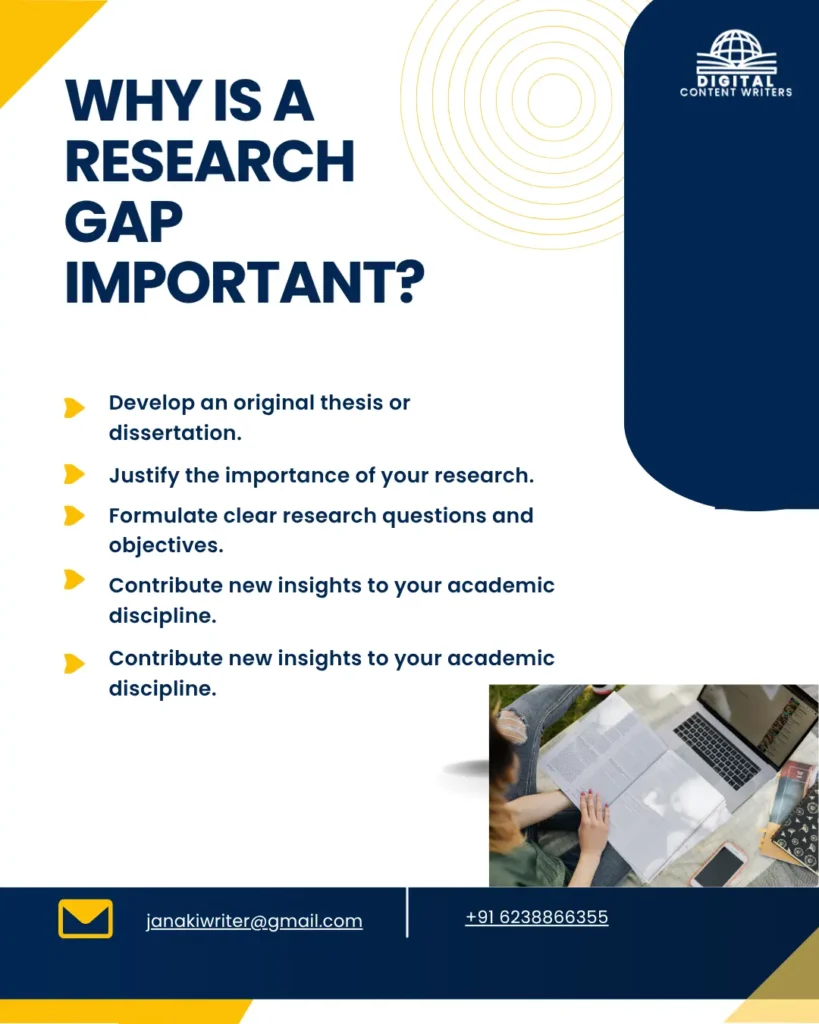
Finding a research gap is essential because it helps you:
- Demonstrate originality in your thesis
- Justify the importance of your research
- Avoid repeating previous studies
- Develop meaningful research questions
- Contribute to existing academic knowledge
- Increase publication potential
- Impress supervisors and examiners
Without a research gap, your thesis may simply repeat existing research rather than adding value to your field.
What Does a Research Gap Look Like?
A research gap may appear as:
- Contradictory findings between previous studies
- Lack of research in a specific geographical location
- Outdated studies requiring updated evidence
- New technologies that previous researchers have not investigated
- Different populations that remain unexplored
- Weak methodologies in existing research
- Missing theoretical perspectives
- Limited long-term evidence
Types of Research Gaps
Understanding different types of research gaps makes them easier to identify.
1. Knowledge Gap
Researchers simply have not answered a particular question.
Example:
There is limited research on AI-assisted academic writing among undergraduate students.
2. Methodological Gap
Previous researchers may have used inappropriate or limited research methods.
Example:
Most studies relied only on surveys instead of combining interviews and observations.
3. Population Gap
A specific group has not been studied.
Example:
Research focuses on urban schools, while rural schools remain underrepresented.
4. Geographical Gap
Most research has been conducted in one country or region.
Example:
Marketing strategies have been studied extensively in Europe but rarely in South Asian markets.
5. Theoretical Gap
Researchers have overlooked certain theories.
Example:
Previous studies used behavioural theory but ignored social learning theory.
Step-by-Step Guide: How to Find a Research Gap in a Thesis
Step 1: Select a Broad Research Area
Start with a general topic that interests you.
Examples:
- Artificial Intelligence
- Digital Marketing
- Nursing
- Climate Change
- Finance
- Psychology
- Education
- Supply Chain Management
Don’t choose your exact thesis title yet.
Step 2: Conduct an Extensive Literature Review
The literature review is where research gaps are discovered.
Search multiple academic databases including:
- Google Scholar
- Scopus
- Web of Science
- PubMed
- IEEE Xplore
- JSTOR
- ScienceDirect
- SpringerLink
- Taylor & Francis Online
Read both recent and highly cited articles to understand the current state of research.
Step 3: Read Systematically
Rather than reading randomly, record the following information from every paper:
- Research objective
- Research questions
- Sample size
- Methodology
- Country
- Findings
- Limitations
- Recommendations for future research
Creating a literature review matrix can help organise this information efficiently.
Step 4: Focus on the Limitations Section
One of the easiest ways to identify research gaps is by examining the limitations section.
Researchers often mention:
- Small sample sizes
- Limited geographical coverage
- Short study duration
- Restricted datasets
- Variables not included
- Recommendations for future studies
These limitations often indicate potential research opportunities.
Step 5: Analyse Recent Publications
Research evolves rapidly.
Read articles published within the last five years to identify emerging topics, changing trends, and unresolved questions.
Recent studies often highlight where additional investigation is needed.
Step 6: Compare Multiple Studies
Do different researchers report different conclusions?
If yes, you’ve likely found an empirical gap.
Example:
Study A concludes remote work increases productivity.
Study B concludes remote work reduces productivity.
This inconsistency creates an opportunity for further research.
Step 7: Identify Understudied Populations
Ask yourself:
- Which age groups are missing?
- Which countries are underrepresented?
- Which industries have not been studied?
- Which educational levels remain unexplored?
Population gaps are among the most common thesis opportunities.
Step 8: Identify Methodological Weaknesses
Ask questions like:
- Were only surveys used?
- Was qualitative research ignored?
- Could mixed methods improve understanding?
- Was the sample too small?
Improving research methodology often creates valuable contributions.
Step 9: Follow Citation Trails
High-quality articles cite earlier foundational studies.
Read:
- Reference lists
- Highly cited papers
- Recent review articles
This approach helps identify how research has evolved over time.
Step 10: Discuss Ideas with Your Supervisor
Your supervisor has experience identifying research gaps.
Share your preliminary observations and ask for feedback before finalising your topic.
Tools That Help Identify Research Gaps
- Google Scholar
- Scopus
- Web of Science
- Connected Papers
- Research Rabbit
- Litmaps
- Zotero
- Mendeley
- EndNote
Tips for Identifying a Strong Research Gap
- Read at least 50–100 quality research papers.
- Prioritise systematic review and review articles.
- Focus on studies published in the last five years.
- Keep detailed notes during your literature review.
- Use citation management software.
- Compare findings across multiple studies.
- Identify recurring recommendations for future research.
- Validate your proposed gap with your supervisor.
Final Thoughts
Finding a meaningful research gap is the foundation of every successful thesis or dissertation. Instead of rushing to choose a topic, invest time in exploring existing literature, comparing findings, identifying limitations, and understanding where further research is needed.
By following the strategies outlined in this guide, you will be able to identify an original and relevant research gap that strengthens your thesis, supports your research objectives, and contributes valuable knowledge to your academic field.
If you’re finding it difficult to identify a genuine research gap, Our thesis writing services at Digital Content Writers India (DCW) can help. Our experienced research experts assist students with comprehensive literature reviews, research gap identification, topic selection, and thesis writing support, ensuring your research is original, relevant, and academically sound
Frequently Asked Questions
Yes. Google Scholar is an excellent starting point for locating recent studies, highly cited papers, and identifying recurring recommendations for future research.
Although there is no fixed number, reviewing at least 50 high-quality papers provides a strong understanding of existing research and helps you identify meaningful gaps.
A research gap refers to missing or insufficient knowledge in existing literature, while a research problem is the specific issue your study aims to investigate based on that identified gap.
Although there is no fixed number, reviewing at least 50 high-quality papers provides a strong understanding of existing research and helps you identify meaningful gaps.
Yes. When previous studies produce contradictory or inconsistent results, it creates an empirical research gap that can be explored through further investigation.