
Table of Contents
Marketing plays a major role in how businesses attract customers, build trust and increase sales. Two important areas within this field are brand marketing and digital marketing. Although they share similar goals, they focus on different aspects of business growth.
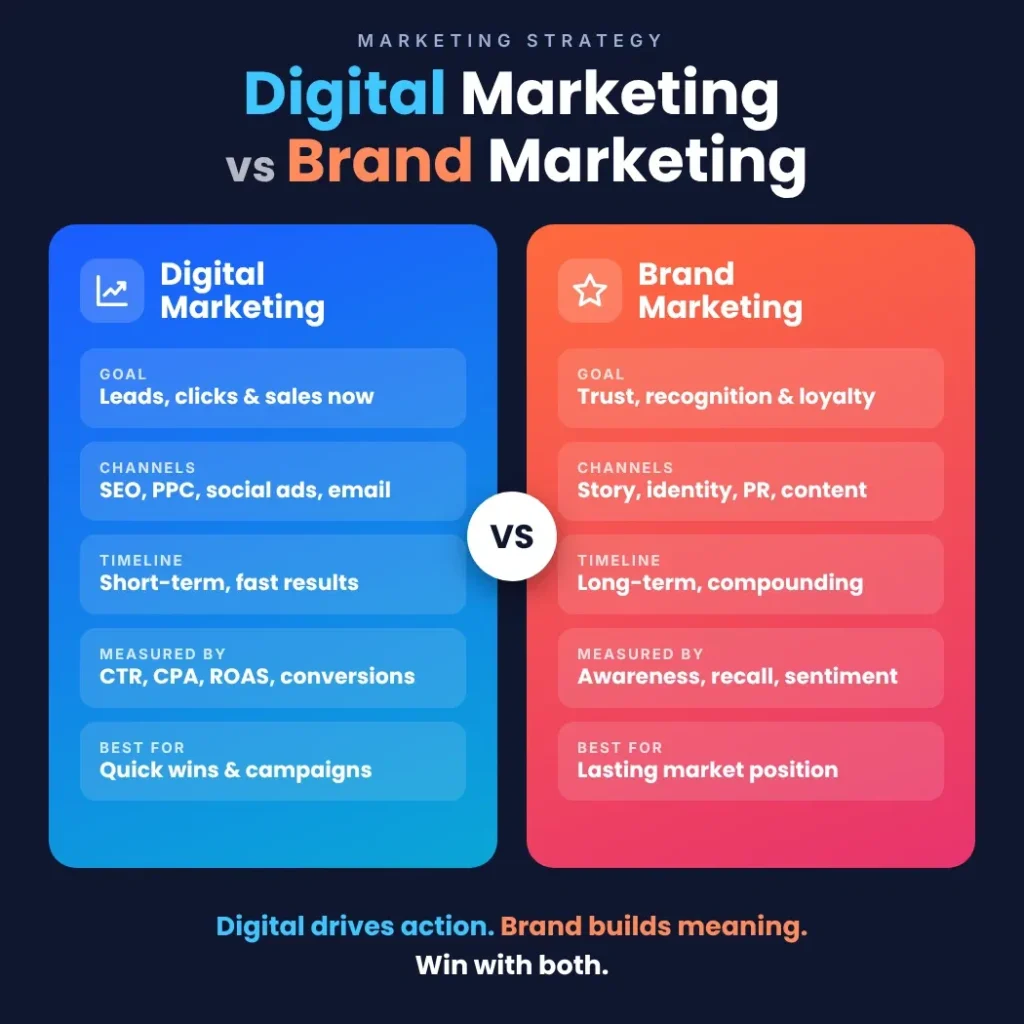
Brand marketing focuses on how people recognise, understand and remember a business. Digital marketing focuses on reaching potential customers through online channels and encouraging them to take action. For example, consider a company launching a new skincare brand.
- Its brand marketing team develops the brand name, logo, positioning, tone of voice, packaging and key messages.
- Its digital marketing team promotes the products through Google Ads, social media, SEO, email campaigns and other online channels.
Both teams work towards the same business goals, but their responsibilities differ.
What Is Brand Marketing?
Brand marketing is the process of promoting a company’s identity, values and reputation to create a lasting connection with its target audience. It focuses on how customers perceive a business and what they associate with its name, products or services. A brand marketer works on the elements that make a business recognisable and memorable. These include brand positioning, messaging, visual identity, storytelling and customer experience.
For example, when people think of Apple, they may associate the brand with premium products, simple design and a distinct customer experience. These associations are built through consistent brand communication and customer interactions over time.
Key Responsibilities of a Brand Marketer
A brand marketer handles several activities that shape how customers view a business.
- Brand Positioning
Defines how a business wants to be recognised in the market. It involves identifying the target audience, studying competitors and developing a clear brand position.
- Brand Identity Development
Works with creative teams to develop brand elements such as logos, colours, typography, packaging and visual guidelines.
- Brand Messaging and Storytelling
Creates messages that communicate the company’s purpose, values, products and unique qualities.
- Market and Consumer Research
Studies customer preferences, buying behaviour, market trends and competitor activities to guide brand decisions.
- Brand Campaign Management
Plans and manages campaigns across different channels to increase brand recognition and customer engagement.
- Brand Reputation Management
Monitors customer feedback, public perception and brand mentions to maintain a positive brand image.
- Brand Performance Measurement
Tracks brand awareness, customer sentiment, brand recall and other indicators of brand health.
What Is Digital Marketing?
Digital marketing refers to promoting products, services and businesses through digital channels. It helps companies connect with their target audiences through search engines, websites, social media, email and online advertising. Unlike traditional marketing, digital marketing offers several ways to measure campaign performance. Businesses can track website visits, clicks, enquiries, conversions and sales to understand how their campaigns perform.
For example, a digital marketing team working for a clothing brand may run Instagram advertisements, improve the website’s Google rankings, publish product-related blogs and send promotional emails.
Key Responsibilities of a Digital Marketer
- Search Engine Optimisation (SEO)
Improves website visibility on search engines by working on keywords, website content, technical SEO and backlinks.
- Social Media Marketing
Plans and manages content across platforms such as Instagram, Facebook, LinkedIn and YouTube to reach and engage target audiences.
- Search Engine Marketing (SEM)
Manages paid advertising campaigns on search engines to attract relevant website visitors and generate leads.
- Content Marketing
Develops blogs, articles, videos, infographics and other content to attract audiences and support business goals.
- Email Marketing
Creates email campaigns to communicate with subscribers, promote products and maintain customer relationships.
- Performance Marketing
Plans and manages paid campaigns with a focus on measurable outcomes such as leads, conversions and sales.
- Analytics and Reporting
Uses tools such as Google Analytics 4, Google Search Console and advertising dashboards to measure campaign performance.
Brand Marketing vs Digital Marketing: Key Differences
Comparison factor | Brand Marketing | Digital Marketing |
Main focus | Brand perception and recognition | Online reach and conversions |
Primary goal | Build brand value and trust | Generate traffic, leads and sales |
Approach | Long-term brand building | Campaign-based and ongoing |
Main activities | Positioning, identity and storytelling | SEO, PPC, social media and email |
Audience connection | Builds emotional associations | Encourages online interaction |
Performance metrics | Brand recall, awareness and sentiment | Traffic, CTR, leads and ROI |
Creative requirements | High | Varies by channel and campaign |
Data requirements | Consumer research and brand tracking | Analytics and campaign reporting |
Common tools | Brand research and design tools | Google Ads, GA4, SEO and social tools |
What Does a Brand Manager Do?
A brand manager is responsible for maintaining and developing a company’s brand identity. The role involves working with different departments, including sales, product development, design and marketing.
Typical responsibilities include:
- Developing brand strategies and positioning.
- Planning brand campaigns.
- Studying consumer behaviour.
- Managing brand guidelines.
- Coordinating with creative and advertising teams.
- Monitoring brand performance.
- Managing product launches and brand communication.
Brand managers often work in FMCG, retail, healthcare, technology, hospitality and other consumer-focused industries.
What Are the Different Job Roles in Digital Marketing?
Digital marketing has several specialisations. Professionals can choose roles based on their interests in content, advertising, search engines, social media or analytics.
Job Role | Main Responsibilities |
Digital Marketing Executive | Supports online marketing activities |
SEO Specialist | Improves organic search visibility |
Social Media Manager | Manages social media content and engagement |
Content Marketing Manager | Plans and manages content strategies |
PPC Specialist | Runs paid search advertising campaigns |
Performance Marketing Manager | Manages campaigns focused on measurable results |
Digital Marketing Manager | Leads digital marketing campaigns and teams |
Growth Marketing Manager | Develops strategies to improve customer acquisition and retention |
Essential Skills for Brand Marketing Professionals
- Strategic Thinking
The ability to understand market conditions, business goals and customer expectations.
- Creative Thinking
Developing fresh campaign ideas and communication concepts that reflect the brand’s identity.
- Storytelling
Communicating a brand’s purpose and values through meaningful messages.
- Market Research
Understanding competitors, customer preferences and industry developments.
- Communication Skills
Working with internal teams, agencies, clients and other stakeholders.
- Project Management
Coordinating campaigns, creative projects and product launches within deadlines.
- Brand Identity Understanding
Knowing how logos, colours, typography, messaging and design influence brand perception.
Essential Skills for Digital Marketing Professionals
- SEO Knowledge
Understanding keyword research, on-page SEO, technical SEO and link-building practices.
- Paid Advertising
Managing Google Ads, Meta Ads and other online advertising platforms.
- Social Media Management
Planning content calendars, managing social platforms and studying engagement patterns.
- Content Creation
Developing blogs, social media posts, website content and other digital assets.
- Data Analysis
Understanding campaign metrics, website traffic, conversions and customer behaviour.
- Marketing Automation
Working with email marketing platforms, CRM systems and automated customer journeys.
- Technical Understanding
Knowing website basics, tracking systems, analytics platforms and conversion optimisation.
Which Tools Do Brand Marketers and Digital Marketers Use?
Brand Marketing Tools | Digital Marketing Tools |
Adobe Illustrator | Google Analytics 4 |
Adobe Photoshop | Google Search Console |
Canva | Google Ads |
Figma | Meta Ads Manager |
Brand research platforms | SEMrush |
Survey tools | Ahrefs |
Presentation tools | Mailchimp |
Brand tracking tools | HubSpot |
Pay Scale- Brand Marketing v/s Digital Marketing
Experience | Brand Marketing – Consumer Tech | Digital / Growth Marketing – Consumer Tech |
3–5 years | ₹20–40 LPA | ₹18–35 LPA |
5–10 years | ₹35–65 LPA | ₹25–80 LPA |
10–15 years | ₹45–95 LPA | ₹60–100 LPA |
15–22 years | ₹75–150 LPA | ₹80–150 LPA |
Conclusion
Brand marketing and digital marketing have different responsibilities, but both contribute to business success. Brand marketing helps businesses establish an identity and build customer trust, while digital marketing helps them reach audiences, generate enquiries and increase online sales. For aspiring professionals, the choice depends on their interests and career goals. For business owners, the better approach is to connect both disciplines and create a consistent experience across every customer touchpoint.
A recognisable brand supported by a clear digital marketing strategy can help a business build stronger customer relationships and compete in its market. Students exploring these areas may need academic guidance when selecting research topics, developing research questions, or structuring their dissertations. Explore our Marketing dissertation help, Digital Marketing thesis help, Digital Marketing dissertation help subject-specific academic support.
FAQs- Brand Marketing v/s Digital Marketing
Both fields offer valuable career opportunities. Brand marketing suits people interested in strategy, storytelling and consumer behaviour, while digital marketing suits people interested in online campaigns, analytics and performance measurement.
No. Brand marketing and digital marketing are separate but connected disciplines. Brand marketing can use both traditional and digital channels, while digital marketing focuses on online promotional activities. Digital platforms can support brand-building campaigns.
Yes. Brand marketing helps small businesses establish a recognisable identity, communicate their values and build customer confidence. It can help them stand out from competitors.
Yes. SEO, social media, content marketing, online advertising and influencer campaigns can introduce a brand to new audiences and increase its visibility.