

Mental Health Nursing Dissertation Help | BSc, MSc & PhD
Last reviewed: January 2026
Mental health nursing dissertation help covers academic support for researching, planning, writing, analysing, and structuring dissertations related to mental health nursing. It may include topic selection, research questions, literature reviews, methodology, data analysis, discussion, conclusions, referencing, and formatting, based on the student’s university guidelines and dissertation requirements.
Mental health nursing dissertation help is academic support for research projects focused on mental health nursing. It covers areas such as topic selection, research questions, literature review, methodology, ethical considerations, data analysis, discussion, conclusions, referencing, and dissertation structure. The support may apply to undergraduate, postgraduate, and doctoral nursing research.
Our professional Mental Health Nursing Dissertation Help service provides end-to-end academic support—covering research design, psychological theories, clinical frameworks, mental health disorders, therapeutic models, evidence-based nursing interventions, and ethical considerations. Our dissertation content is original and human-written, prepared according to the student’s research requirements and university guidelines. Where available, students can also request an AI-detection report as an additional screening check before submission.
Get Your Mental Health Nursing Dissertation Help Now!
High-Quality Help for Mental Health Nursing Dissertations
A Mental Health Nursing dissertation requires deep understanding of psychiatric conditions, patient-centred care, therapeutic communication, mental health assessment tools, crisis intervention strategies, and interdisciplinary collaboration. Our service helps you craft a dissertation that is academically strong, clinically relevant, and aligned with NMC (Nursing and Midwifery Council) guidelines, DSM-5/ICD-11 standards, and evidence-based mental health nursing approaches. We help students work with relevant evidence-based sources and professional standards, including NMC guidelines and NICE guidelines, when developing mental health nursing research. A dissertation evaluating therapeutic interventions for depression in UK mental health nursing could combine peer-reviewed research with relevant NMC professional standards and NICE recommendations, while a dissertation examining global access to mental health services may draw more heavily on WHO frameworks.
Why Choose Our Mental Health Nursing Dissertation Help?

Specialised Mental Health Nursing Experts
Writers with academic and clinical experience in psychiatric nursing, psychology, and behavioural health.

Coverage of All Mental Health Entities & Frameworks
Including depression, anxiety, bipolar disorder, schizophrenia, PTSD, addiction, child & adolescent mental health, trauma-informed care, and therapeutic modalities (CBT, DBT, ACT, psychotherapy).

Research-Focused Approach

Ethically Compliant Work

Plagiarism-Free & Fully Referenced
Fast Delivery & Revisions
What We Cover in Mental Health Nursing Dissertation Help
Our expert support is available for students working on mental health nursing research, clinical topics, and academic projects. If you need broader support across nursing subjects, explore our Nursing Dissertation Help services. We help you with every aspect of mental health nursing research, including:
- Psychiatric assessment tools (PHQ-9, GAD-7, MMSE, MoCA)
- Risk assessment & crisis intervention
- Psychological and behavioural theories
- Mood disorders & anxiety disorders
- Psychotic disorders & neurodevelopmental disorders
- Substance misuse & dual diagnosis
- Trauma-informed care & safeguarding practices
- Interprofessional collaboration models
- Mental health promotion & early intervention
- Patient advocacy and rights
- Community mental health nursing approaches
- Digital mental health interventions (telehealth, mHealth apps)

Types of Mental Health Nursing Dissertations We Handle
We support a wide range of dissertation types, including:
1. Empirical Research Dissertations
- Primary data collection
- Interviews, focus groups, case studies
- Thematic or statistical analysis
- PRISMA flow diagram
- Evidence synthesis & critical appraisal
- Combining qualitative & quantitative data
- Triangulation and integration models
- Intervention evaluation
- Patient outcomes & care models
- Frameworks in mental health nursing
- Comparative model analysis
Systematic Review Methodology Guide
Can I write a systematic review if a similar one already exists?
Yes. A new review may be justified if the previous review is outdated, examines a different research question, uses different criteria, or new evidence has become available.
What is PRISMA?
PRISMA is a reporting guideline for systematic reviews and meta-analyses. It helps researchers report how studies were identified, screened, excluded, and included.
What is the PICO framework?
PICO helps researchers develop focused clinical research questions. P = Population, I = Intervention, C = Comparison, and O = Outcome.
How many studies do I need?
There is no fixed minimum number. The number depends on the research question, search strategy, eligibility criteria, and available evidence.
Can I conduct a systematic review with only a few studies?
Yes. If only a small number of studies meet the predefined eligibility criteria, they can still be included and analysed transparently.
Qualitative vs Quantitative vs Mixed-Methods Comparison
| Feature | Qualitative | Quantitative | Mixed-Methods |
|---|---|---|---|
| Main purpose | Understand experiences, perceptions, meanings, and behaviours | Measure variables, relationships, differences, or trends | Combine numerical measurement with in-depth understanding |
| Type of data | Non-numerical data | Numerical data | Both qualitative and quantitative data |
| Common data sources | Interviews, focus groups, observations, documents | Surveys, questionnaires, experiments, datasets | Combination of qualitative and quantitative sources |
| Typical research questions | “How?” and “Why?” | “How many?”, “How much?”, “What relationship?” | Questions requiring both measurement and explanation |
| Common analysis methods | Thematic analysis, content analysis, narrative analysis | Descriptive statistics, correlation, regression, hypothesis testing | Qualitative and statistical analysis |
| Common software | NVivo | SPSS | SPSS + NVivo, depending on the study |
| Sample size | Usually smaller, purposefully selected samples | Usually larger samples suitable for statistical analysis | Depends on both components |
| Example | Exploring nurses’ experiences of caring for patients with depression | Measuring nurses’ attitudes toward mental health care | Measuring attitudes and exploring nurses’ experiences |
| Best suited for | Exploring complex experiences and meanings | Testing relationships, patterns, or hypotheses | Answering research questions that require both approaches |
Sample Mental Health Nursing Dissertation Topics
- Effectiveness of CBT-based nursing interventions for adolescents with depression
- Role of psychiatric nurses in suicide prevention in emergency settings
- Impact of trauma-informed care on patient outcomes
- Exploring nurse-patient therapeutic communication in schizophrenia care
- The relationship between stigma and help-seeking behaviour among university students
- Evaluating mindfulness-based interventions in managing anxiety
- Use of telepsychiatry in improving access to mental health services
- Nursing strategies to prevent relapse in bipolar disorder patients
- Assessing the effectiveness of motivational interviewing in addiction recovery
- The role of community mental health nurses in supporting dementia caregivers
Our Process for Creating a High-Quality Mental Health Nursing Dissertation
Understanding Your Topic & University Guidelines
We align with your academic requirements, marking rubrics, and research expectations.
Research Proposal Development
We build a clear proposal with background, rationale, research gap, aims, questions, and ethical considerations.
Literature Review
Extensive review of peer-reviewed psychiatric nursing journals, clinical guidelines, and evidence-based publications.
Research Methodology
Selection of research design, sampling methods, data collection tools, reliability, validity, and ethical protocols.
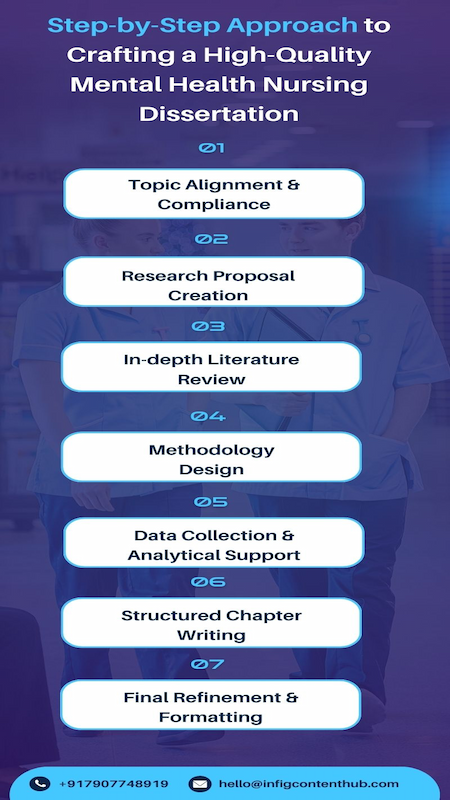
Data Collection & Analysis
Support in qualitative coding, SPSS analysis, thematic interpretation, and graphical representation.
Writing Each Dissertation Chapter
- Introduction
- Literature Review
- Methodology
- Results/Findings
- Discussion
- Conclusion & Recommendations
Final Editing & Proofreading
We refine grammar, coherence, referencing, and formatting.
How to Choose and Narrow a Mental Health Nursing Dissertation Topic
Choosing a focused dissertation topic is an important first step in mental health nursing research. A broad area such as depression, anxiety, dementia, substance misuse, or patient safety can quickly become too extensive for a single dissertation.
- Choose a specific patient group: Focus on adolescents, older adults, people with severe mental illness, or another clearly defined population.
- Define the mental health issue: Narrow broad subjects such as mental health to a specific condition, intervention, experience, or nursing concern.
- Identify a nursing perspective: Consider areas such as therapeutic communication, person-centred care, medication adherence, risk assessment, patient education, or recovery-oriented practice.
- Consider the setting: A topic can be focused further by examining community mental health services, psychiatric hospitals, emergency departments, or other healthcare settings.
- Check research availability: Make sure sufficient recent academic literature and credible evidence are available to support the dissertation.
- Keep the scope manageable: Avoid trying to examine several conditions, populations, interventions, and outcomes in one dissertation.
- Turn the topic into a research question: A clear research question gives direction to the literature review, methodology, data collection, and analysis.
Who Can Benefit From Our Mental Health Nursing Dissertation Help?
Our service is ideal for:
- BSc Nursing students
- MSc / Postgraduate Mental Health Nursing students
- PhD Nursing candidates
- International nursing students
- Students struggling with academic writing
- Working nurses balancing job and studies

Tools, Software & Research Databases We Use - Mental Health Nursing Dissertation Help
Research Ethics in Mental Health Nursing
- Ethical approval – Obtain approval before collecting data.
- Informed consent – Ensure participants understand the study and agree voluntarily.
- Capacity – Assess whether participants can provide informed consent.
- Participant safety – Have procedures for managing distress, risk, and safeguarding concerns.
- Confidentiality – Protect participants' personal and research information.
- Data protection – Store and handle research data securely.
- Right to withdraw – Explain when and how participants can withdraw.
- Anonymity – Remove identifying information when reporting findings.
Global Service -Mental health Nursing Dissertation Help
We support Mental Health Nursing students in the UK, Australia, Canada, USA, Ireland, New Zealand and worldwide.
What Students Say About Our Mental Health Nursing Dissertation Help
Mental Health Nursing Dissertation Help | Qualified Writers

Dr. Priya Nair
- Expertise: Nursing, Public Health, Healthcare Management, Community Care Nursing, Mental Health
- Research Skills: Systematic Literature Reviews, Qualitative Research, Clinical Evidence Synthesis, Healthcare Policy Analysis
- Experience: 13+ years | 600+ nursing academic projects completed.

Janaki Krishnan
- Expertise: MBA, Marketing, HRM, Strategic Management, International Business, Business Planning
- Research Skills: Qualitative & Quantitative Research, SPSS, AMOS, SmartPLS, NVivo
- Referencing Styles: APA, Harvard, MLA, Chicago, IEEE, OSCOLA, Vancouver
- Experience: 16+ years | 1000+ academic projects & business content pieces | Supported thousands of students and hundreds of businesses across the UK, Australia, Canada, Singapore, the UAE, and globally
FAQ – Mental Health Nursing Dissertation Help
Absolutely — we customise your dissertation based on your institution’s requirements.
Yes, every dissertation is original and fully referenced. Students can also request an AI-detection report as an additional screening check before submission.
Yes, we offer express delivery options.
Yes. We use current research from PubMed, CINAHL, PsycINFO, NICE guidelines, WHO reports, DSM-5/ICD-11 frameworks and recent peer-reviewed journals.
Yes. We can design validated tools, semi-structured interview questions, survey instruments and assessment scales appropriate for mental health studies.
We help you refine broad ideas into focused, researchable dissertation topics with clear objectives and a defined scope.
In addition to dissertation support, students can also access our Nursing Assignment Help for assistance with nursing assignments, case studies, essays, and other academic tasks.
Choose a methodology based on your research question, objectives, type of data, and intended analysis. Qualitative, quantitative, and mixed-methods approaches may be appropriate depending on the study.
The required word count depends on your university, academic level, and course requirements. Always follow the dissertation guidelines provided by your institution.
Yes. A systematic review can be used when the research aims to identify, evaluate, and synthesise existing evidence using a structured and transparent methodology.
Ethics approval may be required when your research involves human participants, personal data, patients, or healthcare settings. The specific requirements depend on your university, research design, and study setting.
Yes. Possible topics include the effectiveness, patient experiences, accessibility, implementation, or outcomes of talking therapies such as cognitive behavioural therapy and other psychological interventions.