
Table of Contents
How to write a thesis is one of the most common questions students ask when preparing for their undergraduate, postgraduate, or PhD research. A thesis is not just a graduation requirement; it is an opportunity to demonstrate your research skills, critical thinking, and subject knowledge. From selecting a research topic to presenting well-supported conclusions, every stage requires careful planning, academic writing, and attention to detail.
Many students find thesis writing challenging because it involves conducting extensive research, reviewing scholarly literature, choosing an appropriate methodology, analysing data, and following strict university guidelines. Without a clear plan, the process can quickly become overwhelming.
What is a Thesis?
A thesis is a formal academic document based on original research conducted by a student to investigate a specific research question or problem. It presents evidence, analysis, and conclusions supported by scholarly sources and follows a structured academic format prescribed by the university.
The Main Purpose of a Thesis
A thesis serves several academic purposes, including:
- Demonstrating research skills
- Developing critical thinking and analytical abilities
- Solving a research problem or answering a research question
- Contributing to existing academic knowledge
- Meeting graduation requirements
- Preparing students for research-oriented careers or higher education
Why Thesis Writing Matters for Students
A thesis is often considered the most valuable academic project a student completes during a degree programme. It provides an opportunity to explore a subject in depth while developing skills that are highly valued in both academic and professional settings.
Some of the key benefits of writing a thesis include:
- Develops Research Skills
Students learn how to identify research gaps, review academic literature, collect data, and interpret findings using recognised research methods.
- Improves Critical Thinking
A thesis requires students to evaluate different viewpoints, compare evidence, identify patterns, and draw logical conclusions rather than simply describing existing information.
- Enhances Academic Writing
Students gain experience in writing clearly, structuring arguments, using academic language, and following citation standards.
- Demonstrates Subject Knowledge
A completed thesis reflects a student’s understanding of their chosen discipline and their ability to apply theoretical concepts to real-world or academic problems.
- Supports Career Growth
Employers often value graduates who have completed substantial research projects because they demonstrate initiative, analytical thinking, and problem-solving abilities.
- Prepares Students for Higher Education
Students planning to pursue doctoral studies or research-based careers benefit significantly from the experience gained during thesis writing.
Thesis vs Dissertation: What's the Difference?
The terms thesis and dissertation are often used interchangeably, but their meanings vary between countries and universities.
Feature | Thesis | Dissertation |
Common in | Master’s programmes (many countries) | Doctoral programmes (many countries) |
Purpose | Demonstrates understanding through research | Contributes original knowledge to the field |
Length | Usually 15,000–50,000 words | Often 60,000–100,000+ words |
Research Depth | Moderate to advanced | Extensive and original |
Academic Level | Undergraduate or postgraduate | Primarily PhD |
Types of Thesis
Undergraduate Thesis
An undergraduate thesis introduces students to academic research. It focuses on applying established theories and research methods to investigate a specific topic.
Master's Thesis
A master’s thesis requires students to conduct independent research using recognised research methodologies.
PhD Thesis
A doctoral thesis is the highest level of academic research.
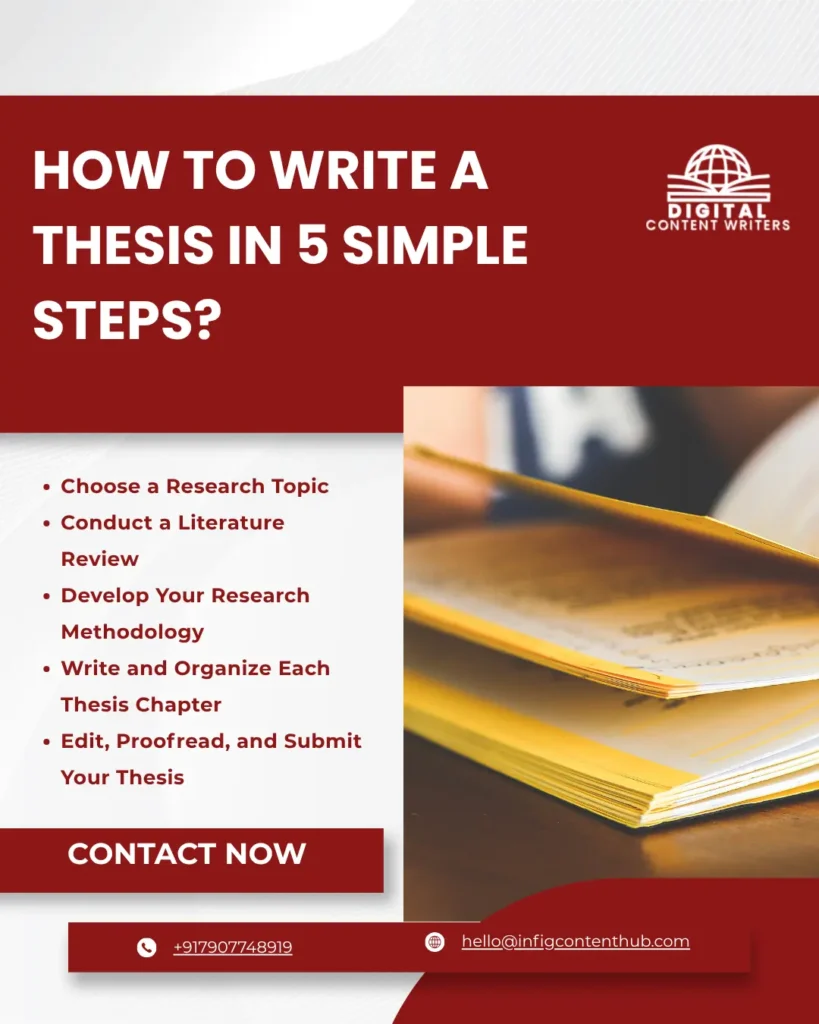
How to Write a Thesis in 8 Simple Steps
Step 1: Choose a Clear and Researchable Thesis Topic
The first step in writing a thesis is selecting a topic that is relevant to your field of study, aligns with your interests, and offers enough scope for research. A strong thesis topic should address a specific problem or research gap rather than a broad subject.
Step 2 : Identify the Research Problem
Every thesis aims to solve a problem or answer a question. After choosing your topic, clearly define the specific issue your research will investigate.
Step 3: Conduct a Literature Review
A literature review examines published research related to your topic. Rather than summarising sources, your goal is to evaluate them critically, compare findings, and identify gaps that your study will address. Once you’ve selected your topic and completed your research proposal, the literature review is one of the first major chapters you’ll write. Our How to Write a Thesis Literature Review guide explains how to search academic sources, organize studies, and synthesize existing research.
Step 4: Develop Research Questions and Objectives
Once the research gap and topic have been identified, the next step is to establish clear research questions and objectives. These elements define what your anatomy nursing thesis aims to investigate and provide direction for the literature review, methodology, data collection, and analysis. Research questions guide your study, while objectives describe what you aim to achieve.
Step 5: Write a Thesis Proposal
Most universities require a proposal before approving your research.
A typical proposal includes:
- Title
- Background
- Problem Statement
- Research Questions
- Objectives
- Literature Review Summary
- Research Methodology
- Timeline
- Expected Outcomes
- References
A well-written thesis proposal demonstrates that your research is feasible and academically valuable.
Step 6: Choose the Right Research Methodology
Qualitative Research
Uses interviews, observations, and case studies to explore experiences and opinions.
Quantitative Research
Uses surveys, experiments, and statistical analysis to measure relationships and test hypotheses.
Mixed Methods
Combines qualitative and quantitative techniques for a more comprehensive analysis.
Choose the methodology that best fits your research objectives.
Step 7 : Collect and Analyse Your Research Data
Choose a research methodology that best suits your study, such as qualitative, quantitative, or mixed methods. Depending on your research objectives, collect data through surveys, interviews, observations, experiments, or secondary sources.
Step 8: Write Your Thesis Chapter by Chapter
Instead of trying to write the entire thesis at once, focus on completing one chapter at a time. A standard thesis usually includes:
- Introduction
- Literature Review
- Research Methodology
- Results
- Discussion
- Conclusion
- References
Maintain a logical flow between chapters, support your arguments with credible sources, and follow your university’s formatting guidelines throughout the writing process.
Characteristics of a Good Thesis
Original
The research should investigate a unique question or offer a fresh perspective on an existing topic.
Well-Structured
Every chapter should follow a logical flow, making it easy for readers to understand the research process.
Evidence-Based
Arguments must be supported by credible academic sources, research findings, and appropriate analysis.
Clear Research Objectives
The thesis should define what the research aims to achieve from the beginning.
Appropriate Methodology
The chosen research methods should align with the research objectives and questions.
Accurate Referencing
All ideas, quotations, and data obtained from other sources must be properly cited.
Conclusion
Writing a thesis is a structured process that requires careful planning, thorough research, and consistent effort. By choosing a strong topic, reviewing relevant literature, selecting the right research methodology, writing each chapter systematically, and revising your work before submission, you can produce a thesis that meets your university’s academic standards. Start early, follow your supervisor’s guidance, and stay organised throughout the process. With the right approach and dedication, completing a high-quality thesis becomes a realistic and rewarding academic achievement.
If you’re feeling overwhelmed by your thesis, Digital Content Writers India (DCWI) is here to help. We provide professional thesis writing services for undergraduate, postgraduate, and PhD students across a wide range of academic disciplines.
How to Write a Thesis? Frequently Asked Questions
Choose a topic that is relevant to your field of study, has sufficient academic literature, addresses a research gap, and can be completed within your available time and resources.
The most common research methods include qualitative research, quantitative research, and mixed methods research. Your choice depends on your research questions, objectives, and the type of data you need to collect.
Write your thesis in your own words, cite all sources correctly, use quotation marks for direct quotes, and review your work with plagiarism-checking software before submission. Proper referencing is essential for maintaining academic integrity.
The required referencing style depends on your university or department. Common citation styles include APA, Harvard, MLA, Chicago, IEEE, OSCOLA, and Vancouver.
Yes. Professional thesis writing services can provide guidance with topic selection, proposal writing, literature reviews, research methodology, editing, proofreading, formatting, and referencing. Make sure any assistance you receive complies with your university’s academic integrity policies.